

Courtney Flatt
Senior CorrespondentCourtney Flatt has worked as an environmental reporter at NWPB since 2011. She has covered everything from environmental justice to climate change.
She began her journalism career at The Dallas Morning News. Later, she earned her master’s in convergence journalism at the University of Missouri and developed a love for radio as a producer at KBIA, an NPR member station in Columbia, Missouri.
In her free time, Courtney enjoys exploring the outdoors. You can find her hiking, kayaking or biking all over the Northwest.
-
 Scientists are seeing way more invasive walleye in the Snake River. That could mean trouble for salmon.
 -
 Salmon like water temperatures just so. Rivers can’t be too hot. But there’s one small spot along the lower Yakima River that could help.
 -
 A harmful algal bloom is once again showing up on the Snake River. This is the fourth year in a row that Whitman County Public Health leaders have warned about algal blooms in the river.
 -
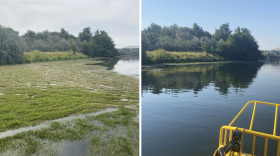 The Yakima River has a problem with water stargrass. It’s a native plant – but it’s choking the waterway and causing problems for people and fish. Now, machines are helping beat back the plant.
 -
 Idaho has taken an aggressive approach to try to rid the Snake River of invasive mussels before they reach the Columbia River. And they said their approach is working.
 -
 For years, the Yakama Nation has fought to restrict access to one of its most sacred sites outside the Tri-Cities. Rattlesnake Mountain, or Laliik, is one of the highest points in the region. And some hikers want access.
 -
 There’s a few places where the Spokane fires didn’t burn quite so hot or quite so fast. Officials with the Washington state Department of Natural Resources say that’s because trees in these areas had been thinned. That helps make a forest ecosystem healthier.
 -
 Health officials plan to continue monitoring the Columbia River in the Tri-Cities after they found harmful algae in the water.
 -
 In Washington state, climate change is expected to bring lower stream flows, warmer winter temperatures and less snowpack in lower elevations. That’s according to a presentation from the state’s climatologist.
 -
 Sockeye numbers are coming in stronger for the Yakima River. That’s months after construction crews in the Tri-Cities removed a land-bridge. It caused the mouth of the river to stagnate.


