

Courtesy: Pierce County Central Labor Council
In Pierce County, an organized body of labor unions is trying to tackle the problem of childcare for working families.The Pierce County Labor Community Services Agency purchased an old elementary school in Tacoma in late September. The nonprofit plans to renovate the building to house child care for around 175 kids.

Courtesy: Pierce County

-
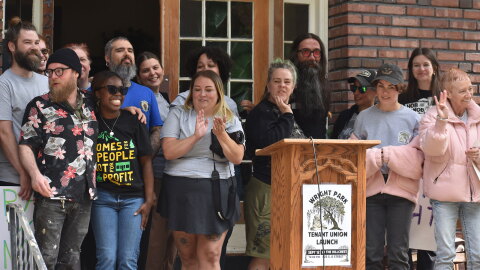 Lauren Gallup/NWPBOn Saturday, underneath a painted banner strung across the porch of Hillcrest Apartments in Tacoma, tenants announced the formation of the Wright Park Tenant Union.
 -
 Lauren Gallup / NWPBKroger, the grocery giant that owns QFC, Fred Meyer and other grocery stores around the country, is planning to close another Fred Meyer in Tacoma. The store sits in the James Center shopping area right across from Tacoma Community College off a busy thoroughfare with a well-used bus line.
 -
 Courtesy: Joe Mabel / Wikimedia CommonsThe city of Tacoma will need to address a $40 million deficit in the 2027-2028 biennial budget.


-
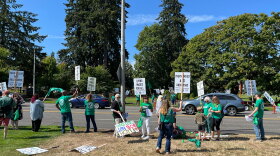 WFSE is in contract negotiations with negotiators for the Washington state Office of Financial Management and the governor’s office. They need to reach an agreement by Oct. 1. But the union has said the state isn’t agreeing to priorities for members, including stronger protections for workers’ safety, or any raises.
 -
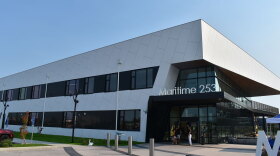 A new ultra-modern, white building sits at the mouth of the Port of Tacoma, just south of the Murray Morgan Bridge. It’s a new skills center, called Maritime|253, for Pierce County high schoolers who are interested in a career in the maritime industry.
 -
 Another harvest season for Washington’s venerated vegetable — the Walla Walla sweet onion — is at an end. Soft and juicy and fragile like a fruit, sweets are as synonymous with the Walla Walla Valley as is wine. And they’re federally protected: Only onions grown in the area can officially be sold as a Walla Walla sweet.
 -
 Northwest cherries are about to ship, a tiny bit early. About 19 million boxes are expected this season – each box is 20 pounds.
 -
 Habitat for Humanity Spokane secures $6.5 million in state funds to expand affordable housing.
 -
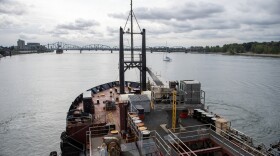 The federal agency that maintains the Columbia River’s shipping channel is proposing to build seven giant in-water pens as part of a $377 million project to manage dredge spoils.
 -
 For the first time in the event’s history, an Indigenous sovereign nation will formally be a part of the 2026 FIFA Men’s World Cup.
 -
 Farmworkers who believe they were discriminated against by their former employer, Cornerstone Ranches, can now seek compensation through a $1 million settlement secured by the Washington state Office of the Attorney General.
 -
 From Wenatchee, Washington, to Owyhee, Oregon, farmers and ranchers are making tough choices about water. Poor winter snowpack throughout the region is to blame. Farmers and ranchers are looking at a dry spring, summer and fall irrigation season.
 -
 Potentially contaminated Manila clams were harvested and shipped to retailers in Washington, Oregon, California and six other states.


