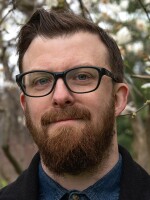
When Aiden Wolf learned he had the chance to attend Whitman College on a new scholarship for regional Native American students, his mother wasn’t completely on board.
The history of the college’s namesake — the missionary and doctor Marcus Whitman — doesn’t sit well with Wolf’s family. They’re enrolled members of the Confederated Tribes of the Umatilla Indian Reservation, or CTUIR, which comprise the Cayuse, Umatilla and Walla Walla peoples.
In 1847, a band of tribal members killed the doctor, his wife and others. Tensions increased between tribes and settlers and more violence followed. In 1850, five Cayuse men were convicted and hanged for the “Whitman Massacre”; Wolf descends from two of them.
So, when it came time for Wolf to pick a college, his mother thought twice about Whitman “because of that history,” he said.
But, he said, his parents also wanted what was best for him. In the end, Wolf — who had doubts, as well — went to Whitman.
“It turned out to be a great decision for me,” Wolf said.
A new scholarship
This month, Wolf and Lindsey Pasena-Littlesky will be the first Šináata Scholars to graduate from the college. Wolf majored in theater, while Pasena-Littlesky majored in environmental studies and politics.
Named after a Cayuse word meaning “to seek,” the scholarship is part of the college’s effort to both acknowledge its history with local tribes and to forge a better relationship with them “while providing an opportunity for education at Whitman College for tribal students,” said Jeanine Gordon, Whitman’s special assistant to the president for Native American outreach.
The full-ride scholarship supports students connected to the CTUIR. Students who are members of the tribes present at the 1855 Walla Walla Treaty Council — an event held on the future site of Whitman College — are also eligible.
For Wolf and Pasena-Littlesky, the Šináata meant they didn’t have to worry about debt and could focus on their studies. It also meant they would help build bridges between the college and their culture.
The scholarship, Wolf said, “really plays this role in representation of Native communities, Native peoples, so it feels great to be a part of something bigger than myself.”

A college’s legacy
Whitman College has had to reckon with Marcus Whitman’s legacy, echoing experiences of other institutions across the U.S. that are named after divisive figures.
Around the time of Whitman's mission, increasing numbers of non-Indian immigrants claimed land the U.S. government didn't own but offered anyway. The Cayuse, Umatilla and Walla Walla tribes attended negotiations and signed the 1855 treaty, agreeing to live on the Umatilla Indian Reservation.
The old story that cast Whitman as a martyr who sought Native Americans’ spiritual salvation — in fact, he converted very few Natives — and the U.S.’s expansion into the Pacific Northwest helped save the college from going under in the late 19th century, according to Blaine Harden, the author of the 2021 book “Murder at the Mission.”
The city-owned Marcus Whitman statue on campus has been repeatedly tagged. On Indigenous Peoples Day in 2024, vandals spray-painted the words “Whitman is on stolen land” and “We are still here.”
Over the past decade, Whitman College has adopted a land acknowledgement and signed a memorandum of agreement with the CTUIR.
The college has also taken steps to attract Native American students and teach the Walla Walla community about Native culture. It now holds an annual First Foods Festival and Pášx̣apa Powwow. At the Cleveland Commons on first Fridays, diners can enjoy fish, game meat, root vegetables and berry preserves at a First Foods Station.
And there’s the Šináata. First offered in 2022, the scholarship continues to grow: The 2025-2026 academic year saw six new scholars.
Culture and connection
Pasena-Littlesky is a community member of the CTUIR and an enrolled member of the Hopi Tribe of Arizona. She said her scholarship was “not about just me, it’s about the impact it had on this campus.”
In her sophomore year, Pasena-Littlesky co-organized a two-day, campus-wide Salmon Film Festival.
Along with film screenings, an art exhibit depicted people’s relationship to salmon through clay, paint and sculpture. Leaders from different Indigenous tribes came and spoke, as well as tribal scientists, professors and policy analysts. A salmon dance performance featured drumming and dancing.
At Ankeny Field, elders dug a fire pit and roasted salmon on stakes. The traditional salmon bake took place from morning until evening when the salmon was served for dinner.
As Pasena-Littlesky walked across campus, she could see her culture being practiced.
Her non-Native peers spoke with her family and friends who were doing the baking — the former passionate about salmon conservation because they’d grown up enjoying and caring for watersheds, the latter because of their culture; salmon is considered a “first food.” Two groups, through different backgrounds, connecting over a shared love.
“That kind of exchange is what this Šináata Scholarship is about,” she said.