





Editor’s note: This story is part of NWPB's efforts to report not just on problems, but on how our communities are seeking solutions. Want to see more stories like this? Let us know at [email protected]. Support this kind of work by donating today.
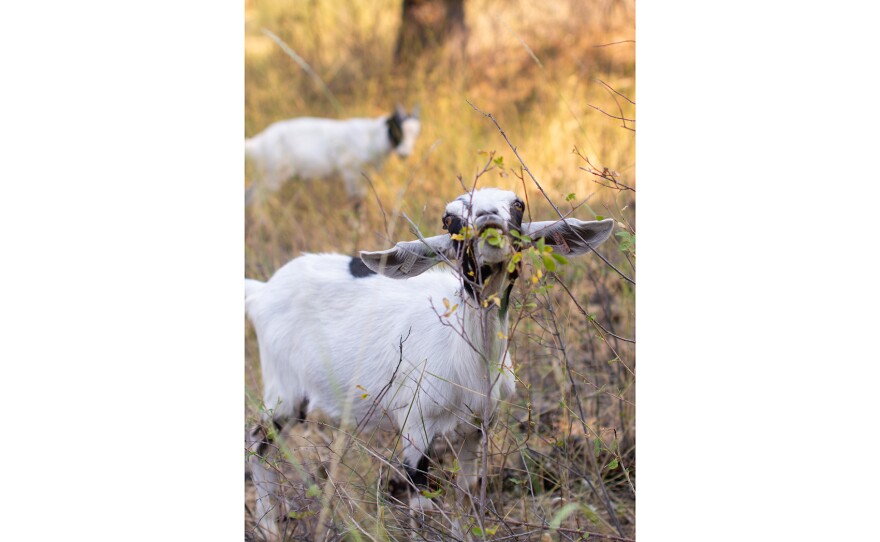
On a late July morning on a rocky slope near Spokane, Washington, Craig Madsen is watching his goats attack snowberry bushes, hawthorn and Oregon grape.
Madsen owns a company that rents goats for a variety of regional jobs. Today, that job is to remove brush that could act as a carrier fuel for wildfires and threaten a nearby home. The homeowners use a tractor to clear fuel in other areas, Madsen said, but that doesn’t work on the hill.
“They can't really use the equipment on it, so we use the goats on it to knock back the brush and reduce the fine fuels,” he said.
The goats also have some other benefits: unlike heavy machinery or herbicides, well-managed grazing has minimal environmental or health risks associated with it, leaving only animal droppings to fertilize the soil.
It’s not exactly a new strategy. But increasingly, landowners are exploring their options.
Maurice Robinette, a cattle farmer in Cheney, Washington, first took an interest in targeted grazing for fuel mitigation three years ago after he saw the Gray Fire’s impact on two different neighbors’ properties.
The first neighbor had done fuel reduction, including heavy grazing, on his property. The second hadn’t done any fuel reduction.
When fire reached the first neighbor’s field, Robinette said, the lack of vegetation slowed it enough that it stopped when it hit a major highway.
But the fire in the field next to it — the one owned by the second neighbor — had a lot more fuel.
“It jumped the highway and continued on towards the south, and burned another 500 acres, I’d guess,” Robinette said.

He said because the fire jumped from that second neighbor’s property, at least six homes were threatened.
According to data from the National Interagency Fire Center, wildfire suppression cost an average of almost $1,200 per acre in 2023.
Costs to use goats for fuel reduction are often a few hundred dollars per acre, with prices varying depending on factors including time spent, desired outcomes and the time of year. While new plant growth tends to be nutritionally dense, animals grazing on dry, dead plants may require supplementation to stay healthy.
Different grazing and browsing animals are also suited to different fuel management needs. Sheep and cattle can both be effective on grassland.
Goats, who exhibit more “browsing” tendencies, prefer a wider assortment of foods including brush and broadleaf plants. They also like to climb. That means they’re often the ideal animals to deal with things like blackberries, thistle and shrubs other animals steer clear of.
Following that fire, Robinette connected with a friend who owned sheep, and decided to run a demonstration on his land. He wanted to show other landowners and the state’s Department of Natural Resources of what the potential was.
“It worked out real well,” Robinette said. “There was almost no fuel left on the ground.”
For several years, Madsen said, he worked with the city of Spokane to reduce fuels near homes in places like Minnehaha Park and Palisades Park in east Spokane, and other wildland-urban interfaces.
Goats could be well-suited to what might be called “point protection” scenarios in small spaces, said Matt Reeves, a research ecologist at the United States Forest Service. The goats are also a good conversation starter, he said, because people think they’re cute.
“The Forest Service and the (Bureau of Land Management) both are beginning to, I think, quite dramatically increase the number of projects where they're using goats,” he said.
Land managers are quick to point out that grazing and browsing animals can’t be used everywhere.
A few limitations include the number of animals available for a job, specific timing needed to protect native plants, and the costs to transport animals.
Animals also need to be acclimated to their environment. Even goats, whom the public has somewhat mistakenly been led to believe will “eat anything,” are slow to try a plant until they know it’s safe, Madsen said.
“ It's about the animals learning from their mothers and their experience in foraging,” Madsen said. “You know, what’s good for them and what’s not.”
Sometimes, grazing can be used in conjunction with other fuel mitigation techniques like prescribed fire. Robinette is looking into controlled burns, he said. But one advantage of grazing is that it’s less of a liability if something goes wrong.
“The downside of prescribed burns is it can get away from you,” he said. “The guy who lit the match is responsible for damages. And that's a huge deterrent.”
Reeves says government agencies are in the process of collecting data related to the efficacy of targeted grazing for fire prevention. Right now, there isn’t much research.
“We are really anxious to partner with people and organizations to try and make that happen,” he said.
Reeves says there’s no one solution to wildfire problems. But with mindful application, grazing could be a helpful tool for fuel mitigation.
This story was updated to correct the spelling of Maurice Robinette’s last name.
Read the audio script here.
