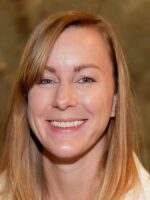
Two candidates are vying to replace U.S. Rep. Dan Newhouse, a Republican representing Washington’s 4th Congressional District. Newhouse is not running for reelection.
Now, John Duresky, a Democrat, and Amanda McKinney, a Republican, are vying to represent the district.

Washington’s 4th Congressional District covers most of Central Washington, including Douglas, Okanogan, Grant, Yakima, Benton and Klickitat counties. It also serves parts of Adams and Franklin counties.
McKinney, who describes herself as an “America First” candidate, has served as a Yakima County Commissioner for six years.
President Donald Trump endorsed her early in the race in a Truth Social post, calling McKinney a “very successful Business Executive, Civic Leader, and Highly Respected Yakima County Commissioner.”
Duresky is an Air Force veteran. He also worked at the Hanford Field Office, overseeing tank waste cleanup.
Duresky, the Democrat running to replace Newhouse, has not served in an elected office. However, he said his previous experience has been spent “solving problems, meeting deadlines, and being accountable to taxpayers.”
The two candidates spoke about cost of living, agriculture and rural healthcare issues during a recent candidate forum hosted by Northwest Public Broadcasting, AARP Washington, the League of Women Voters of Benton-Franklin counties and the League of Women Voters of Yakima County.
Cost of living
Both candidates acknowledged the difficulties rising prices have put on people across Washington.
“ Affordability is not a buzzword,” Duresky said. “ You hear that all the time in rural America, people working two jobs and a side hustle. We have seen grocery prices rise and rise.”

Duresky said tariffs and trade wars have contributed to the economic situation. He said trade practices shouldn’t be set by the executive branch. Instead, Duresky said, Congress should hold that power.
He also said the war in Iran is causing rising fuel costs.
McKinney said fuel prices were already inflated after the Obama and Biden administrations.
“ The reality is that there is prosperity outside of the four corners of Washington state, and we are not experiencing it because of our state policies,” she said, pointing to state policies to restrict natural gas and increase carbon-free energy development.
McKinney said she’d like to continue with the Trump administration’s energy policies, including the expansion of nuclear power.
She disagreed that tariffs and the trade war have driven up costs. Instead, McKinney said costs are up due to overregulation from the state government.
“ This has been death by a thousand cuts,” she said.
Agriculture
In submitted questions, farmers from the district raised concerns about diesel prices, the cost of farm workers and entire crops going unpicked.
After growing up in a Central Washington farming family, McKinney said she would increase competition for suppliers for items like fertilizer and seeds. She also said Washington needs to “regrow our cattle herds.”
“Making sure that we can actually have common sense practices on the farm that let us deliver the food to the table. So, deregulation is going to be key there,” McKinney said.
In some agricultural sectors, like the dairy industry, McKinney said she’d like to expand the H-2A visa program, which she described as “ an absolute godsend to our community.” However, she said workers must go home.
“ We want people to be in our country legally. And that way we can bifurcate this issue from immigration,” McKinney said.
For his part, Duresky said he “hoed beans as a kid.” He said the H-2A program needs to be easier to implement, especially for small growers.
“ That's what I'm most interested in — is helping those small growers,” Duresky said.
He said tariffs damaged the state’s export markets.
Rural healthcare
Another question raised concerns about Washington’s rural hospitals, some of which are at risk of closure after cuts to Medicaid in the Trump administration’s “One Big Beautiful Bill Act,” formally known as H.R. 1.
Duresky said he’d like to “undo” H.R. 1. Duresky said he’s concerned by its impacts. He said he’d heard from one man who “almost had to have his toe amputated because there was no podiatrist in town.”
He said small communities can “dry up” if a rural hospital leaves town, noting Washington's reimbursement rates for Medicaid and Medicare are “among the lowest in the nation.”
In addition, Duresky said, upcoming Medicaid work requirements will further limit people’s insurance and strain rural hospitals.
“ Fixing that on day one is going to be the biggest job,” he said.
McKinney agreed that rural hospitals are “under duress.” However, she said it’s not because of H.R. 1. Instead, she said, the rural healthcare crisis has been building for decades.
After the Affordable Care Act, she said, “ We saw government get more involved in our healthcare, and the result is higher costs, lower quality of care.”
She said universal healthcare would drive up costs and decrease access.
To keep healthcare providers in rural areas, McKinney suggested paying down their student loan debt, something the state has attempted to do to help increase public defenders. The bill has not yet become law.
“ I think a lot of providers would want to come to communities if they knew they didn't have a huge expense waiting for them, and they're needing to go to a large metropolitan area for a big career,” she said.
Election Day is on Tuesday. Ballots are due in drop boxes that day by 8 p.m.
If mailing in ballots, Washington’s Secretary of State recommends mailing them more than a week in advance. Accessible voting is available at county elections offices or voting centers until 8 p.m. on Election Day.